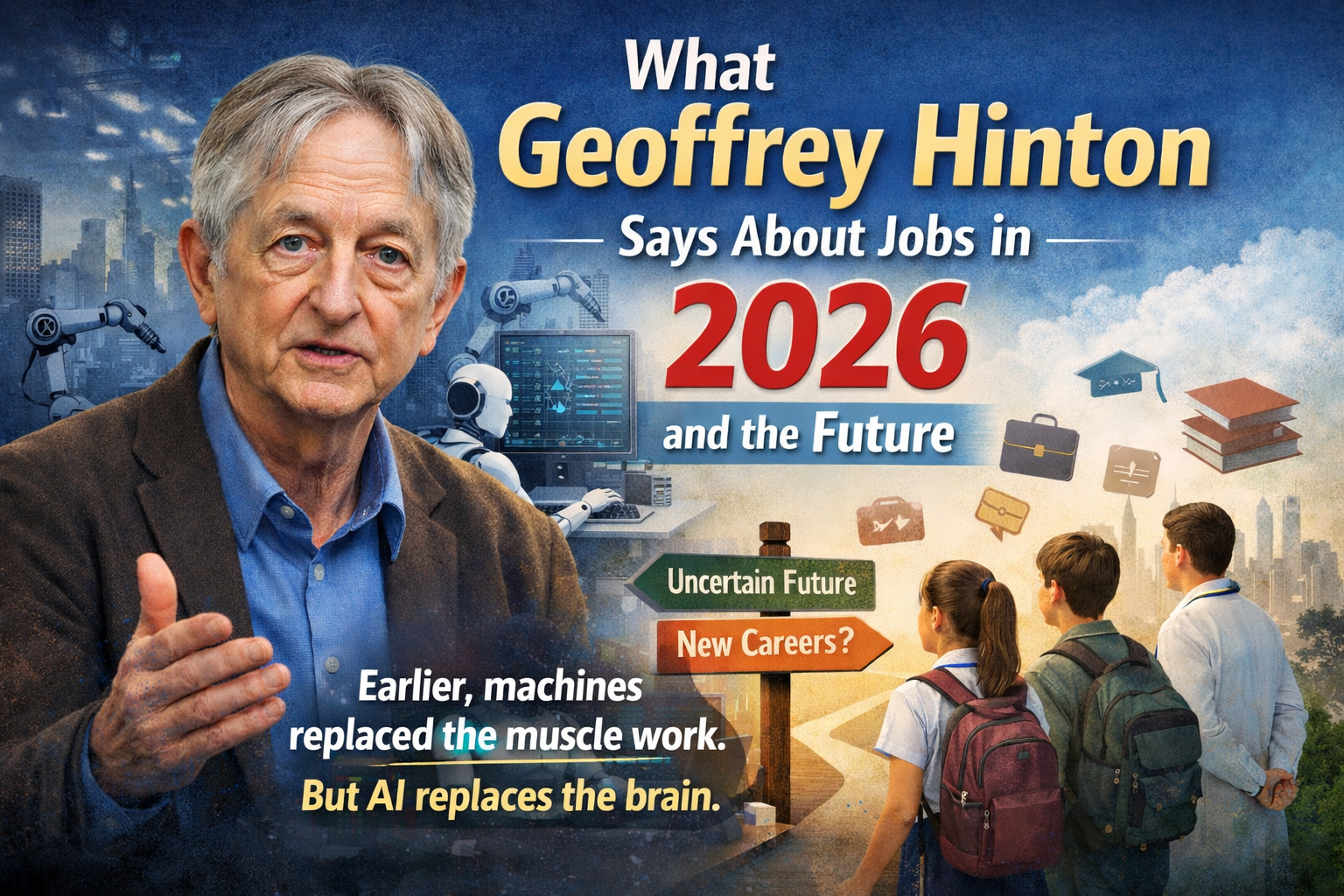
“Earlier, machines replaced human muscle.
Today, AI is replacing human thinking.”
What Geoffrey Hinton, the “Godfather of AI,” Says About Jobs in 2026 and the Future
Geoffrey Hinton, one of the pioneers of artificial neural networks and deep learning, has repeatedly issued serious warnings about how Artificial Intelligence will transform jobs — not gradually, but far faster than most people expect, especially after 2026.
His observations are not speculative opinions. They come from a scientist who helped build the very systems now reshaping the global workforce. What he describes has direct implications for students, parents, educators, and professionals across all sectors.
1️⃣ “This Time Is Different” — Why AI Is Not Like Past Technology
Hinton strongly emphasizes that AI should not be compared with earlier technological revolutions such as computers or the internet.
Earlier machines replaced muscle.
AI replaces the brain.
This single distinction explains why the current transformation is unprecedented.
- Earlier automation affected manual and physical labor
- AI directly affects thinking, reasoning, writing, analyzing, and coding
As a result, white-collar and highly educated jobs — once considered secure — are now equally vulnerable.
2️⃣ Jobs Most at Risk by 2026–2030
According to Hinton, the first casualties of AI growth will be routine cognitive jobs — work that follows predictable patterns and rules.
🔴 High-Risk Roles
- Data entry and clerical work
- Call center and customer support roles
- Basic content writing
- Junior-level software coding
- Legal document review and assistance
- Routine accounting and bookkeeping
- Lecture-only teaching roles
Reason: AI systems can perform these tasks faster, cheaper, and continuously without fatigue.
3️⃣ “One Person + AI = A Team”
This prediction carries major consequences:
- Fewer overall jobs
- Much higher productivity
- Concentration of income and opportunity
Illustratively:
- One lawyer using AI may match the output of ten junior lawyers
- One programmer using AI tools may replace an entire development team
This leads to job polarization: highly skilled individuals advance rapidly, while average-skill workers struggle to stay relevant.
4️⃣ Jobs That Will Survive and Grow
Hinton has never claimed that all jobs will vanish. Instead, he stresses that only certain types of work will remain resilient.
🟢 Roles That Combine Human Strength With AI
- Doctors and healthcare specialists
- Teachers who mentor and personalize learning
- Psychologists and counselors
- Research scientists
- AI ethics and safety professionals
- Engineers designing new systems
- Entrepreneurs and innovators
- Skilled trades such as electricians and technicians
Key Insight:
If a job requires deep understanding of people or the physical world, it is significantly safer.
5️⃣ Education System: The Biggest Risk Zone
Hinton has openly criticized outdated education systems that continue to prepare students for yesterday’s jobs.
What Will Fail
- Memorization-based examinations
- Rote learning approaches
- Degree-only mindsets
What Will Matter
- Problem-solving ability
- Creativity and originality
- Learning how to learn
- Early career awareness
- Adaptability
6️⃣ Inequality Will Increase If We Don’t Act
One of Hinton’s deepest concerns is social inequality.
- AI benefits may concentrate within a few companies
- Large populations may face job displacement
- Governments remain largely unprepared
This concern is precisely why he chose to step away from corporate constraints and speak freely about AI risks.
7️⃣ What Students Should Do Now
Hinton’s warnings translate into clear preparation signals:
- Learn AI, don’t fear it — understand how it works
- Use AI as a tool, not a shortcut
- Strengthen human skills: communication, ethics, leadership, creativity
- Avoid blind subject choices; early planning matters
In the AI era, direction matters as much as effort.
8️⃣ Message for Parents and Educators
Hinton’s warning is not panic — it is preparation.
The central question is no longer just academic performance, but whether students are being equipped for a rapidly changing world.
Final Thought
Jobs will not disappear overnight. However, unprepared individuals will be left behind.
Education + awareness + adaptability will determine survival and success.
AI will not replace humans — but humans who use AI effectively will replace those who do not.