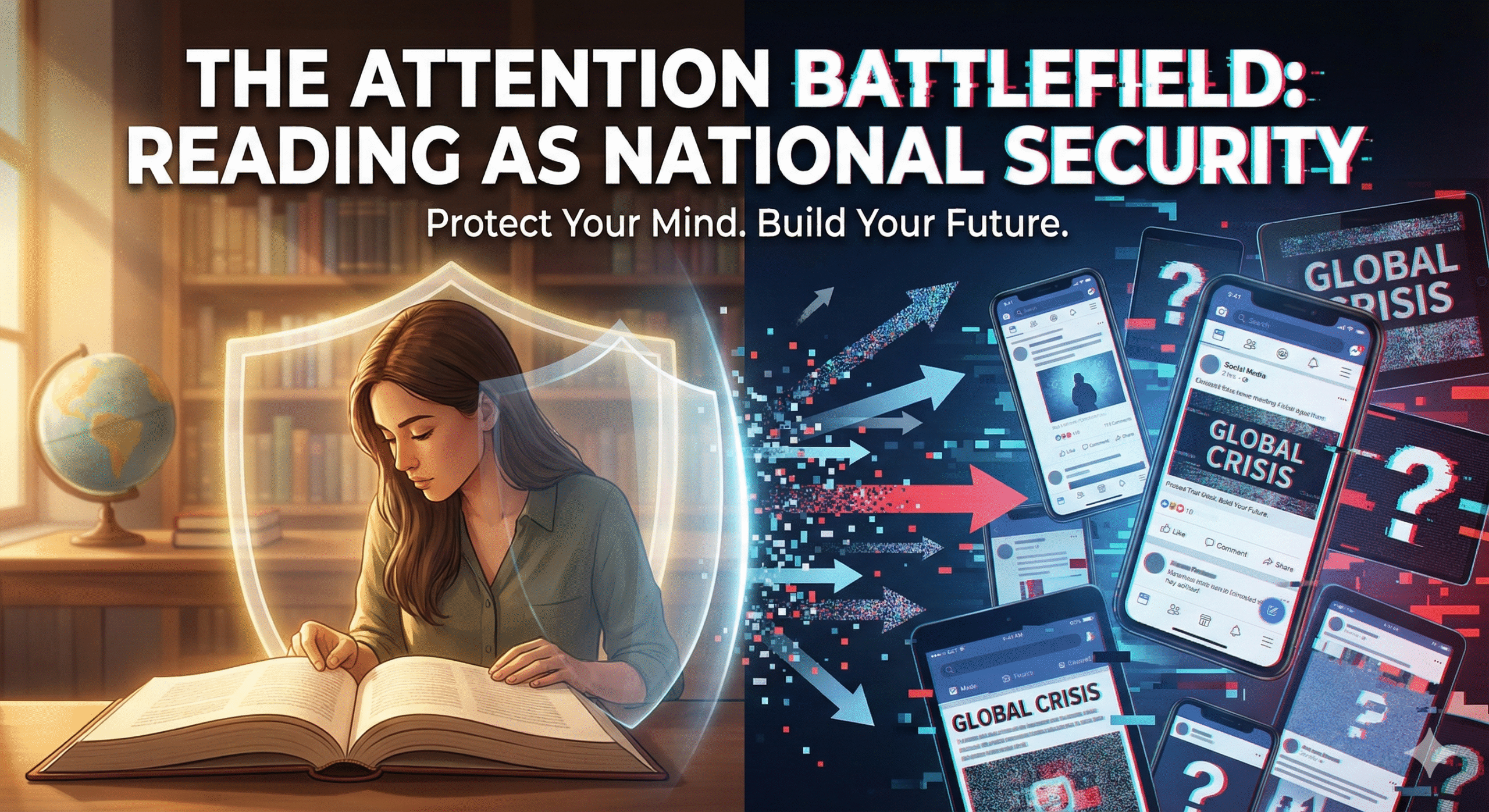
The New Battlefield: Why Reading is Now a National Security Issue
In the olden days, wars were fought with ships, spies, and weapons. Today, a new frontline has opened up: our attention spans.
It sounds like the plot of a dystopian novel, but it is the reality facing governments worldwide. Recently, Bridget Phillipsson, the UK’s Education Secretary, made a startling declaration: the decline in reading is no longer just an educational challenge—it is a national security threat.
Why are world leaders raising the alarm? And what does this mean for our schools, our homes, and our future careers?
The Problem: A Crisis of Attention and Truth
We live in an age where information is fast, answers are instant (thanks to AI), and patience is thin. The “attention economy” is booming, but our ability to focus is busting.
According to a recent analysis by Vantage with Palki Sharma, the logic is terrifyingly simple: Children who do not read are easier targets for misinformation.
When a generation loses the habit of “deep reading”—the ability to focus on a complex text for an extended period—they lose the critical thinking skills required to spot fake news. Governments argue that hostile actors are exploiting this vulnerability, spreading fake headlines that non-readers struggle to identify as false.
The Research: The Numbers Don’t Lie
The decline is not anecdotal; it is statistical.
- The “1 in 3” Reality: According to the National Literacy Trust (NLT), reading enjoyment has hit a historic low. Recent data indicates that only around 33% of children say they enjoy reading in their free time. This is the lowest figure recorded in two decades.
- The Gender Gap: The drop is even steeper among boys, who are ditching books for screens at a much faster rate than girls.
- The Link to Misinformation: Research by Kolinsky et al. (2022) found that individuals with lower literacy levels were significantly more likely to endorse conspiracy theories. Conversely, “critical reading” acts as a protective shield for the brain.
Global Solutions: From the UK to Uttar Pradesh
Governments are not just watching; they are acting.
- In the UK: The government is launching family reading drives and upgrading school libraries. Their motto? The antidote to disinformation is not more internet firewalls, but “more readers.”
- In India: The state government of Uttar Pradesh has introduced mandatory newspaper reading in government schools. For 10 minutes every day, students must read major news and editorials to reduce screen time and engage with reality.
What Can We Do?
We cannot wait for government mandates to save our attention spans. Here is the path forward:
- For Teachers: Bring back the newspaper. Dedicate 10 minutes of “device-free” time to read physical news. It grounds students in reality.
- For Students: Reading is one of the few activities that rewires your brain to be smarter and harder to fool. In a world of 15-second reels, having the attention span to read a book is a superpower.
🚀 A Challenge for Every Parent: Are You Ready for the Future?
We talk about children needing to read more, but what about us parents?
The biggest hurdle in career guidance today isn’t a lack of opportunities; it is a lack of awareness. Most parents only know about a handful of traditional careers (Engineering, Medicine, Law). But the world has evolved. There are now over 3,000 unique career paths—from AI Ethics to Sustainable Architecture—that didn’t exist a decade ago.
If you don’t know a career exists, how can you suggest it to your child?
We propose the “One Career a Day” Habit:
- The Resource: Access our library of 3000+ career paths.
- The Habit: Read just one career profile or success story daily.
- The Result: By the time your child needs guidance, you will be an informed mentor, not a worried parent.
Click above to start reading about future careers today.
Conclusion
The world doesn’t fit into a 280-character tweet. As Palki Sharma eloquently put it, “A book may not fight for your attention, but it definitely rewards it.”
Let’s not lose the war for our minds. Tonight, put the phone down. Read a page. Whether it is a novel to build empathy or a career guide to build a future—just read.
Written by:
JAINODDIN MOHAMMAD
Certified Career Analyst
Ph. 9700449221