Beyond the Syllabus: The Structural Metamorphosis of Education in 2025
1. The Great Shift: Operationalizing Educational Intent
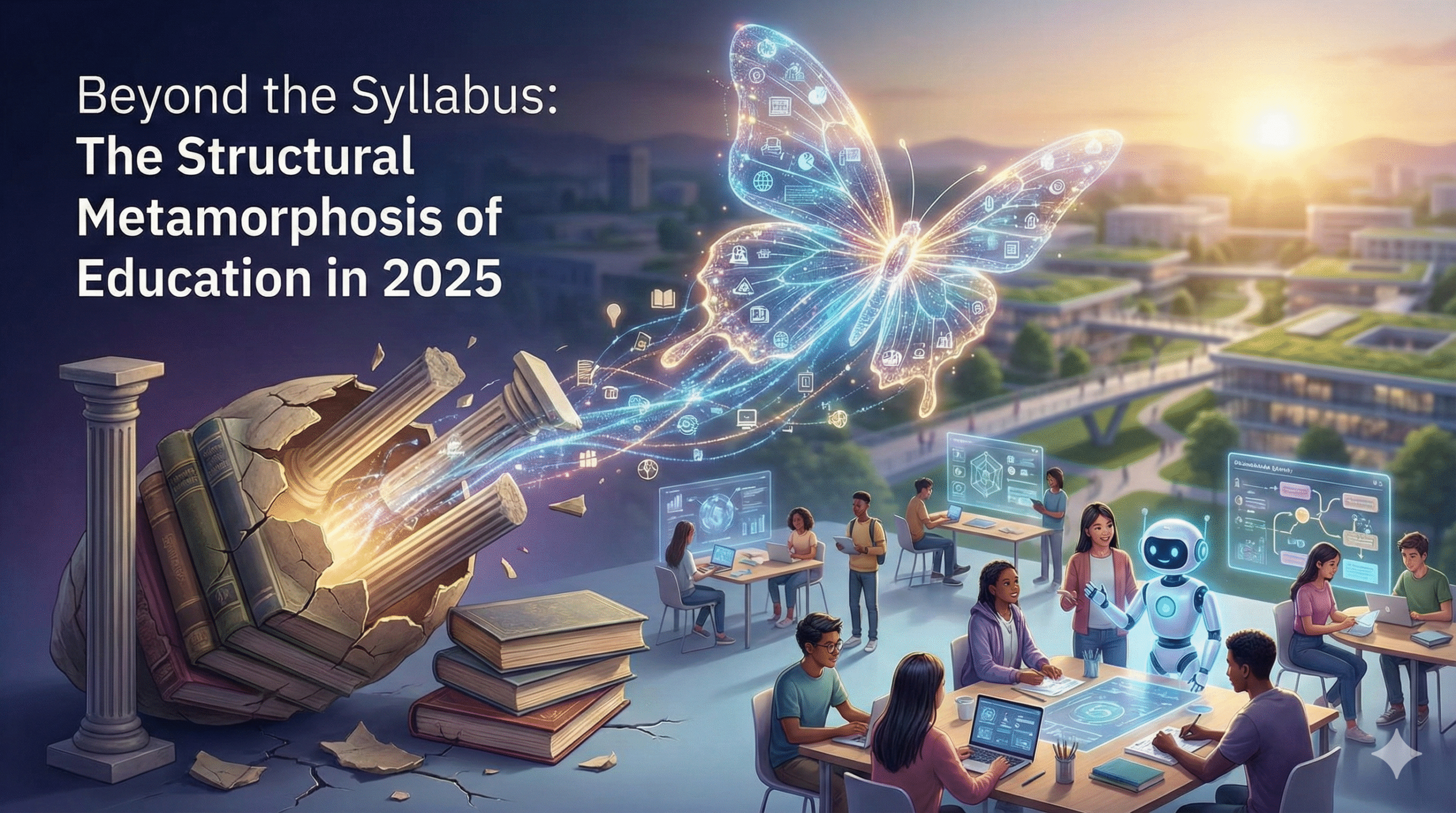
By the close of 2025, the educational landscape had undergone a metamorphosis that was less about introducing new textbooks and more about reimagining the fundamental architecture of learning. If previous years were defined by policy announcements and ambitious frameworks, 2025 was the year of “operationalization”—the distinct moment when high-level intent finally translated into ground-level practice. Across the education system, a quiet but profound revolution occurred, shifting the focus from compliance-driven schooling to purpose-led education.
2. The New Classroom: From Syllabus Coverage to Sense-Making
The most visible transformation has been the pedagogical pivot from content-heavy instruction to competency-based learning. For decades, the metric of a successful school year was syllabus coverage. In this new era, that metric has shifted to capability development.
- The Facilitator Model: The modern classroom has moved away from the industrial factory model—where knowledge is dispensed to passive recipients—toward an environment that prioritizes “sense-making.” Educators are no longer arguably the sole keepers of information; instead, they function as facilitators who help students understand how to think rather than just what to know.
- Connecting the Dots: This shift has revived an almost ancient, inquiry-based approach to learning, where students engage in experiential projects, learning by doing and through peer collaboration. The curriculum is no longer a rigid ladder to be climbed but a flexible web of interdisciplinary pathways, allowing students to connect dots between mathematics, arts, and social sciences in real-time.
3. Assessment Reform: The Shift from Judgment to Insight
As pedagogy evolved, so too did the mechanisms of measurement. The education system is witnessing the slow death of the “episodic exam”—the high-stakes, one-time test that previously determined a student’s worth. In its place, a system of “continuous insight” has emerged.
- Diagnostic Tools: Assessment in 2025 is increasingly viewed as a diagnostic tool rather than a judgment. Schools are utilizing rubrics, extensive portfolios, and reflective journals to map a student’s growth trajectory over time.
- Beyond the Scorecard: By leveraging psychometrics and longitudinal data, educators can now see a panoramic view of a learner’s potential, capturing skills like critical thinking, collaboration, and adaptability that traditional marks could never quantify. This move toward skills-based evaluation is critical in ensuring that students are not just exam-ready, but life-ready.
4. Technology & AI: The Humanizing Power of Automation
Parallel to these structural changes is the sophisticated integration of technology. The initial apprehension surrounding Artificial Intelligence (AI) has matured into thoughtful adoption. Rather than fearing AI as a replacement for human intellect, the education system has embraced it as a powerful equalizer and enabler.
- Personalization at Scale: AI tools are now routinely used to create personalized learning pathways, adapting content to the specific pace and learning style of each student.
- Focusing on the Human Element: This automation of administrative and content-delivery tasks has remarkably humanized the classroom. With technology handling the “drudge work,” teachers have been freed to focus on what machines cannot replicate: mentorship, empathy, and ethical guidance.
5. Holistic Development: Embedding Social-Emotional Learning (SEL)
This renewed focus on the human element is most evident in the elevation of Social-Emotional Learning (SEL). In the past, “value education” was often an afterthought, relegated to a single period once a week. In the generalized scenario of 2025, SEL is embedded into the very cultural fabric of educational institutions.
From conflict resolution strategies woven into group projects to daily practices of mindfulness, schools are acknowledging that academic rigor cannot exist without emotional stability. The realization that a calm classroom is a productive classroom has led to a holistic approach where mental well-being is treated with the same seriousness as academic proficiency.
6. Navigating Challenges: Change Fatigue and Alignment
However, this systemic overhaul has not been without significant growing pains. The transition has placed immense pressure on the human capital of the education system.
- The Burden on Educators: “Change fatigue” has become a tangible challenge, as teachers are expected to evolve their skill sets faster than institutional support systems can sometimes manage. There is a delicate tension between the need for innovation and the capacity for adaptation.
- The Expectation Gap: Furthermore, a challenge of alignment persists; while schools sprint toward the future, they often face friction from parents and stakeholders who still view education through the lens of traditional metrics and demand the certainty of the old systems.
7. The Strategic Imperative: Integrating Early Career Awareness
Perhaps the most critical “missing link” addressed in 2025 was the gap between academic learning and professional reality. Career awareness has evolved from a one-time counseling session to a continuous curriculum. Schools have realized that students cannot aspire to be what they cannot see.
By integrating industry insights directly into subjects—connecting mathematics to data science or history to public policy—schools are demystifying the professional world. This approach ensures that decision-making is treated as a core skill. When students eventually leave the school gates, they are equipped not just with a certificate, but with “directional confidence,” significantly reducing the anxiety of future choices and aligning their skills with emerging market realities.
8. Conclusion: A New Definition of Leadership and Success
Ultimately, the narrative of education in 2025 is one of resilience and profound redirection. Leadership within schools has transformed from administrative management to instructional mentorship, with principals and directors actively shaping the learning culture rather than just overseeing operations.
The system is moving toward a future where the goal is to produce learners who are not just academically qualified, but adaptable human beings. The transition is ongoing, but the foundation has been laid for an education system that values the development of the whole human being over the mere accumulation of data.
Start Your Journey
Explore 100+ career paths and find detailed information about your dream job.
Open Career LibraryDiscover your strengths and get a tailored roadmap with our career assessment.
Get Personalized GuidanceWritten by
JAINODDIN MOHAMMAD
Certified Career Analyst and Counsellor in International Studies
Ph. 9700449221